

Decision Makers Exposed by Grant Calder
Decision Makers Exposed by Grant Calder
🌍 Unmask the global agenda
🚫 Explore what rarely gets discussed
💰 Discover who profits from decisions
🚨 Discover who benefits from crises

Decision Makers Exposed Audiobook

Decision Makers Exposed Part II
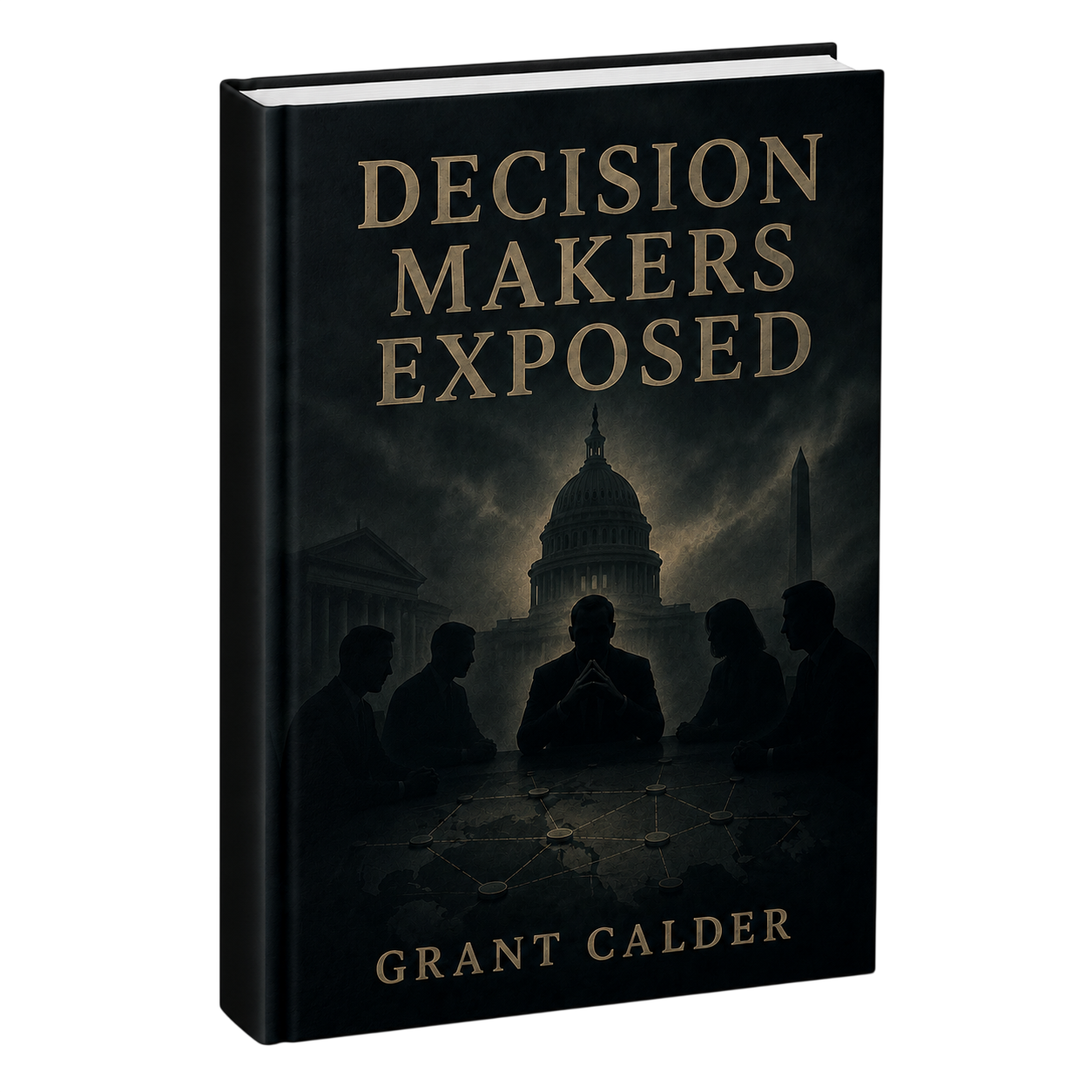
WHAT THIS BOOK REVEALS
Decision Makers Exposed explores the networks, incentives, and institutions that influence how major decisions are shaped across modern society. Rather than focusing on isolated events or secret conspiracies, it examines recurring patterns that appear across politics, finance, media, technology, healthcare, and global institutions.
Through historical examples, institutional relationships, and interconnected systems, the book encourages readers to look beyond the final decisions presented to the public and consider what happens before they reach that stage. It explores how financial interests, professional networks, lobbying, access, and aligned incentives can influence public policy, economic outcomes, media narratives, and the direction of powerful institutions.
Whether you're interested in political influence, financial power, media narratives, corporate interests, or institutional decision-making, Grant Calder offers a framework for recognizing the forces that can shape important decisions long before the public ever becomes aware of them.
Patterns of Global Influence
Throughout modern history, major shifts in finance, governance, institutions, and information have shaped the way influence moves through society. This book explores recurring patterns that continue to appear across different eras.
The most important patterns are often visible only when viewed across decades rather than days.
WHAT YOU'LL DISCOVER
Explore the systems, incentives, and power structures that influence politics, media, finance, and public perception behind the scenes.

How the Pieces Connect
Political decisions, financial systems, media narratives, institutions, and technology often appear separate on the surface. This book explores how these structures can intersect, influence one another, and shape broader outcomes.
Understanding individual events is easy. Understanding the systems that connect them is where the deeper picture begins.

Hey, I’m Grant
In Decision Makers Exposed, researcher and author Grant Calder investigates how major decisions take shape across governments, corporations, financial institutions, media, and technology. He examines the networks, incentives, and relationships that influence outcomes long before those decisions ever reach public attention.
After more than a decade of studying political institutions, financial influence, and modern systems of power, Grant found that influence rarely depends on a single person or organization. It emerges through aligned incentives, institutional relationships, and access to decision-makers, creating systems where certain interests repeatedly gain a stronger voice than others.
Grant’s work helps readers understand how influence is built, how important decisions are shaped, and how institutional power operates across seemingly separate industries. His mission is to give ordinary readers a clearer framework for looking beyond headlines, questioning how decisions are made, and recognizing the forces that may benefit from the outcomes.
FREQUENTLY ASKED QUESTIONS
When will I receive it?
When will I receive it?
Right after purchase you get instant access. A download link for the book will be sent directly to your email and available on the checkout page.
Is this just another conspiracy book?
Is this just another conspiracy book?
No. This book does not rely on wild speculation or fear-driven theories. Instead, it explores hidden influence through documented history, psychology, economics, media systems, and patterns of power that most people simply never notice.
Are these “Decision Makers” real people or just a metaphor?
Are these “Decision Makers” real people or just a metaphor?
They are not presented as a secret club of villains in a dark room. Instead, “decision makers” refers to the networks, institutions, and individuals who influence decisions without public attention including banking elites, media architects, policy shapers, corporate interests, and unelected power brokers.
Why haven’t I heard about this before?
Why haven’t I heard about this before?
Because real power doesn’t want attention, it wants stability, compliance, and silence. Schools teach surface-level history. Media focuses on headlines, not origins. This book simply pulls back the curtain.
Could reading this make me paranoid?
Could reading this make me paranoid?
The goal is the opposite. True awareness leads to calmness, not panic. Understanding the system reduces fear because you finally see the pattern—rather than feeling something is wrong without knowing why.
Will this still be relevant in the future?
Will this still be relevant in the future?
Yes. The systems described in this book are not temporary events, they are long-standing structures of power and influence that adapt but never disappear. Understanding them will always matter.
Does this book encourage rebellion or chaos?
Does this book encourage rebellion or chaos?
No. It encourages awareness, responsibility, and mental sovereignty, not violence, extremism, or chaos. Real power is regained quietly, through clarity, not loud revolt.
Can young readers or students understand this book?
Can young readers or students understand this book?
Yes, if they have curiosity and basic understanding of society. The language is clear and does not require advanced political or economic knowledge. It’s written for thinkers, not scholars.
What if I disagree with what’s written in the book?
What if I disagree with what’s written in the book?
That’s expected, and welcomed. This book is not asking for belief, but for attention and thought. You don’t need to agree with everything to benefit from questioning what you’ve always been told.